


Preamble: When Ancient Intelligence Meets Digital Futures
Long before silicon chips, algorithms, and artificial intelligence defined human progress, civilizations were already engineering intelligence through simple yet powerful tools. Among the most enduring of these tools is the abacus, a cognitive instrument dating back over 4,000 years, used across Mesopotamia, China, Japan, and few African economies (with Ghana as the star pupil, leading the charts in Africa) to model numbers, logic, and problem-solving. Far from being obsolete, contemporary neuroscience and educational psychology now affirm that abacus training can increase working memory capacity by up to 30–40%, enhance mental calculation speed by over 200%, and significantly improve concentration, spatial reasoning, and cognitive flexibility in children through to their adulthood overall productivity in their various niches, professionally.
It is against this compelling historical and scientific backdrop that the maiden edition of the Unveiling the Genius in You series was launched, under Season 6 of the African Renaissance and Sustainability Engagement (ARISE) Webinar Events. Moderated masterfully by Ms. Catherine Diko, with strategic and intellectual support from Dr. Lucy Anning, the session explored how ancient computational wisdom is now reshaping Africa’s digital future.
The webinar featured an in-depth interview with our Genius of the season, Mr. Gyekye, the CEO of Smart Intellectual Consult, an organization pioneering abacus programming and early-stage coding education in Ghana. The session powerfully demonstrated that the journey from beads to binary is not only symbolic but a practical, measurable, and transformative course.
Webinar Highlights: Insights from the Frontiers of Cognitive Education
The Bold Pioneering Initiative of Smart Intellectual Consult in Engineering Intelligence from the Ground Up
In this series, Mr. Gyekye opened the discussion by introducing Smart Intellectual Consult, a Ghana based educational firm dedicated to equipping children with abacus mastery, arithmetic intelligence, and foundational coding skills. The organization’s mission is bold and precise to the core with the passionate mission to cultivate young minds capable of solving complex numerical problems, building logical frameworks while transitioning seamlessly into coding and digital innovation.
By integrating abacus training with introductory programming concepts, Smart Intellectual Consult positions children as learners to groom them into future creators of technology, a critical shift in Africa’s educational narrative.
Why the Abacus Still Matters in the 21st Century
At the heart of the discussion was a central question, thus, Why the abacus in a world of calculators and AI?
Mr. Gyekye’s response was unequivocal establishing that unlike passive digital tools, the abacus actively rewires the brain. Studies referenced during the session indicate that children trained in abacus arithmetic exhibit heightened bilateral brain activity, engaging both the left (logical) and right (creative) hemispheres simultaneously.
The webinar traced the evolution of the abacus from the Chinese suanpan to the Japanese soroban, placing prominence on how these variations laid the conceptual groundwork for binary logic, the very language of modern computing. In essence, the abacus is not a relic but can be referred to as the ancestor of digital computation.
Cognitive Transformation Where High IQ, Confidence, and Mental Speed is Developed
One of the most compelling segments focused on the cognitive dividends of abacus education.
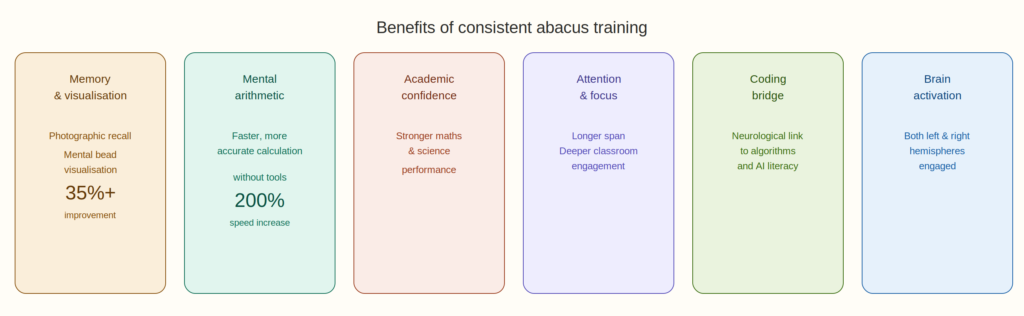
According to insights shared during the webinar, consistent abacus training can:
- Improve photographic memory and visualization skills by over 35%
- Increase mental calculation accuracy and speed dramatically
- Boost academic confidence, especially in mathematics and science
- Enhance attention span and classroom engagement
Children trained on the abacus begin to perform calculations mentally by visualizing the beads— effectively transforming the mind into a biological processor. This mental discipline, Mr. Gyekye emphasized, creates a strong neurological bridge to coding, algorithms, and AI literacy.
From Abacus to Algorithms as a Pathway to Preparing Africa’s Digital Natives
A defining moment of the webinar was the clear linkage drawn between abacus cognition and coding logic. Binary systems from zeros and ones to mirroring the bead movements of the abacus factoring in the presence and absence as well as value and null. This parallel makes abacus-trained children statistically more adaptable to programming languages such as Python, Scratch, and JavaScript.
Mr. Gyekye, our guest genius, argued that early exposure to abacus learning does not merely improve numeracy but also acts to accelerate digital fluency, positioning African children to compete in a global tech economy projected to be worth over USD 15 trillion by 2030.
Reclaiming Africa’s Cognitive Legacy for a Digital Renaissance
The webinar concluded on a powerful and resonant note. As emphasized by Ms. Catherine Diko and Dr. Lucy Anning, Africa’s renaissance will not be imported but rather, be intellectually engineered. The abacus, though ancient knowledge, offers a strategic tool for reclaiming Africa’s place in global knowledge systems by nurturing homegrown intelligence, innovation, and confidence from childhood.
The maiden edition of Unveiling the Genius in You was not merely a webinar but a critical call to action. A call to parents, schools, policymakers, and development partners to invest in cognitive infrastructure, not just the physical infrastructures. Supporting abacus and early coding education is, ultimately, an investment in Africa’s human capital, technological sovereignty, and sustainable future.
The session closed with Mr. Gyekye sharing contact details for Smart Intellectual Consult, inviting collaboration and enrollment while reaffirming a shared commitment to supporting young professionals and retelling Africa’s story through innovation, intellect, and impact.
Indeed, from beads to binary, the message was clear, in that, the future belongs to the selected minds trained to think—deeply, logically, and creatively.
Dr. Lucy Anning
Director,
DevAfrica Institute
